The history of virology is an impressive journey that reflects our relentless pursuit to understand and combat unseen foes. It all began in the late 19th century when scientists like Jenner and Pasteur started developing vaccines, although the true nature of viruses was still a mystery. Dmitri Ivanovsky’s breakthrough in 1892, showing infectious sap from diseased tobacco plants, paved the way for Martinus Beijerinck to introduce the term “virus.” The field exploded in growth during the 20th century with significant breakthroughs, including the identification of human viruses and life-saving vaccines. Today, as we face new viral threats like SARS-CoV-2, past lessons are crucial for shaping future public health responses.
The Origins of Virology: A Historic Perspective
Virology’s origins trace back to the late 19th century, when the unseen world of viruses began to unfold. The term “virus” itself was coined by Martinus Beijerinck in 1898, following Dmitri Ivanovsky’s groundbreaking work with diseased tobacco plants. Ivanovsky’s use of a filter to show that the infectious agent could pass through, indicating it was smaller than bacteria, marked the beginning of a new scientific field. This discovery prompted deeper inquiry into infectious agents that could not be seen or cultured using traditional methods.
As researchers ventured further into the mysterious realm of viruses, the early 20th century revealed critical breakthroughs. The identification of bacteriophages by Frederick Twort and Félix d’Herelle opened the door to understanding how viruses could infect bacteria. This discovery not only highlighted the complexity of viral interactions but also laid the foundation for later developments in virology that would benefit medicine and agriculture alike.
Walter Reed’s work in 1900 was another pivotal moment. He proved that yellow fever was transmitted by mosquitoes, marking the first identification of a human virus. This discovery underscored the importance of understanding viral transmission dynamics and set the stage for future research into vector-borne diseases. As technology advanced, the introduction of the electron microscope in the 1930s allowed scientists to visualize viruses for the first time, revealing their intricate structures and solidifying their status as distinct biological entities.
The origins of virology reflect a rich tapestry of curiosity and determination. The early findings sparked a cascade of research that paved the way for significant public health advancements, including vaccines and treatments for various viral diseases. Each discovery built upon the last, revealing the critical role viruses play in our world, both as pathogens and as tools for genetic research and therapy.
Pioneers of Virology and Their Contributions
The field of virology owes much to its early pioneers who laid the foundation for understanding viruses and their impact on health. Edward Jenner, often regarded as the father of immunology, developed the first successful smallpox vaccine in 1796. His work not only saved countless lives but also set the stage for future vaccine development. Louis Pasteur followed, creating vaccines for rabies and anthrax, further proving the potential of vaccination as a means to combat infectious diseases.
In 1892, Dmitri Ivanovsky’s groundbreaking experiments with tobacco mosaic virus marked the first identification of a virus. He demonstrated that the infectious agent could pass through a filter that trapped bacteria, challenging the existing paradigms of disease causation. This work was expanded upon by Martinus Beijerinck, who coined the term “virus” and established the concept of viruses as distinct entities.
The early 20th century saw significant advancements with the discovery of bacteriophages by Frederick Twort and Félix d’Herelle. These tiny viruses that infect bacteria opened new doors in microbiology and virology, leading to the exploration of viral therapies. Walter Reed’s work in 1900 on yellow fever highlighted the role of viruses in human disease, marking a pivotal moment in medical history.
The invention of the electron microscope in the 1930s allowed scientists to visualize viruses for the first time, leading to the identification of numerous viruses that cause diseases in humans, animals, and plants. The collaboration among researchers during this period accelerated the understanding of viral structures and functions.
Throughout the 20th century, the efforts of these pioneers and their successors contributed to the development of vaccines against major viral diseases. The eradication of smallpox in 1980 is a testament to their work, showcasing what can be achieved through rigorous research and public health initiatives. The legacy of these pioneers continues to inspire modern virologists as they face new challenges and strive to protect global health.
- Louis Pasteur and the development of the rabies vaccine
- Edward Jenner and the smallpox vaccine
- Robert Koch’s work on disease causation
- Dmitri Ivanovsky and the discovery of viruses
- Wendell Stanley and the crystallization of viruses
- Max Theiler’s development of the yellow fever vaccine
- Albert Calmette and Camille Guérin’s work on BCG vaccine
Early Discoveries: From Tobacco Mosaic Virus to Human Viruses
The discovery of the Tobacco Mosaic Virus (TMV) in the late 19th century marked a pivotal moment in virology. Scientists Dmitri Ivanovsky and Martinus Beijerinck studied the disease affecting tobacco plants and found that the infectious agent could pass through a fine filter, which was previously believed to filter out all bacteria. This led to the realization that a new type of pathogen existed, one much smaller than bacteria. Beijerinck’s term ‘virus,’ derived from the Latin word for poison, underscored the harmful nature of these entities.
As research progressed, the early 20th century saw the identification of the first human virus—yellow fever. Walter Reed’s groundbreaking work in 1900 demonstrated that this disease was transmitted by mosquitoes, highlighting the importance of vectors in viral transmission. This breakthrough not only opened avenues for understanding viral infections but also encouraged public health initiatives to combat mosquito-borne diseases.
Alongside these discoveries, the exploration of bacteriophages by Frederick Twort and Félix d’Herelle brought new insights into the relationship between viruses and bacteria. Bacteriophages, or phages, are viruses that infect bacteria, and their discovery paved the way for future research on viral ecology and potential therapeutic applications. This era laid the groundwork for understanding complex interactions within ecosystems, including the roles of viruses in regulating bacterial populations.
The introduction of the electron microscope in the 1930s enabled scientists to visualize viruses for the first time. Researchers like Wendell Stanley were able to crystallize TMV, further revealing its structure and properties. This technological leap provided critical evidence that viruses were indeed distinct entities, leading to a more profound understanding of their biology and behavior.
These early discoveries were instrumental in establishing virology as a scientific discipline. They not only highlighted the existence of viruses but also set the stage for ongoing research into their role in health and disease, shaping the future of virology and paving the way for vaccine development and disease prevention.
The Rise of Vaccines: Milestones in Public Health
 Credits: avalere.com
The development of vaccines has been one of the most significant milestones in public health, fundamentally changing the landscape of disease prevention. The concept of vaccination began with Edward Jenner’s smallpox vaccine in 1796, which laid the foundation for immunology. Jenner’s innovative approach involved inoculating individuals with material from cowpox lesions, ultimately leading to immunity against smallpox. This groundbreaking work not only demonstrated the potential of vaccines but also inspired future research into viral immunization.
By the early 20th century, the field of virology saw rapid advancements. The vaccine for rabies, developed by Louis Pasteur in 1885, further showcased the effectiveness of vaccination in preventing viral diseases. The mid-20th century marked a pivotal era with the introduction of the polio vaccine by Jonas Salk in 1955, followed by Albert Sabin’s oral polio vaccine in the early 1960s. These vaccines were instrumental in reducing polio incidence worldwide, demonstrating the power of vaccination programs in eradicating diseases.
The widespread use of vaccines has led to significant public health achievements, such as the near-eradication of measles and the elimination of smallpox. The World Health Organization’s successful smallpox eradication campaign in the late 20th century stands as a testament to the effectiveness of coordinated vaccination efforts.
The evolution of vaccines continued with the development of the hepatitis B vaccine in the 1980s and the introduction of combination vaccines that protect against multiple diseases with a single shot. Recent innovations include mRNA vaccines, such as those developed for COVID-19, which represent a new frontier in vaccine technology. These vaccines have shown rapid effectiveness and adaptability, crucial in responding to emerging viral threats.
Throughout history, vaccines have not only reduced mortality rates but have also reshaped societal norms around health and disease prevention. The collaborative efforts of scientists, public health officials, and communities have played a vital role in the success of vaccination campaigns, highlighting the importance of public trust and accessibility in achieving widespread immunization.
Technological Advancements in Virology Research
 Credits: news.gatech.edu
The field of virology has vastly benefited from technological innovations that have enhanced our understanding of viruses and their interactions with hosts. One of the most significant breakthroughs was the invention of the electron microscope in the 1930s, which allowed scientists to visualize viruses for the first time. This technology revealed the structural complexity of viruses, paving the way for more detailed studies.
In the 1980s, the development of molecular techniques such as polymerase chain reaction (PCR) revolutionized virology research. PCR enables the amplification of specific DNA or RNA sequences, making it easier to identify and study viruses even in minute quantities. This technique has played a crucial role in diagnosing viral infections, including HIV and more recently, SARS-CoV-2.
The advent of next-generation sequencing (NGS) in the 21st century has further propelled virology into a new era. NGS allows for the rapid sequencing of entire viral genomes, facilitating the identification of new viruses and understanding their evolution. For example, during the COVID-19 pandemic, NGS was instrumental in tracking viral mutations and understanding the spread of different variants.
Bioinformatics has also emerged as a vital tool in virology. By applying computational methods to analyze viral data, researchers can predict viral behavior, assess risks, and develop targeted treatments. This interdisciplinary approach enhances our ability to respond to viral outbreaks effectively.
Additionally, technological advancements in vaccine development, such as mRNA technology, have transformed how we combat viral infections. The rapid development of mRNA vaccines for COVID-19 demonstrates the potential of this technology to respond swiftly to emerging viral threats.
These advancements not only aid in research but also play a critical role in public health, enabling quicker responses to viral outbreaks and improving vaccination strategies.
Challenges in Virology: The HIV/AIDS Epidemic
The HIV/AIDS epidemic, which emerged in the 1980s, presented one of the most significant challenges in the history of virology. Initially identified among certain populations, HIV (Human Immunodeficiency Virus) quickly became a global crisis, affecting millions. The virus attacks the immune system, leading to AIDS (Acquired Immunodeficiency Syndrome), which leaves individuals vulnerable to opportunistic infections and certain cancers.
The response to HIV/AIDS illustrated the complexities of viral research and public health. Early on, misinformation and stigma surrounded the disease, complicating prevention and treatment efforts. Activism played a crucial role in pushing for more research, funding, and the development of effective therapies. As a result, the 1990s saw the introduction of antiretroviral therapy (ART), which transformed HIV from a fatal diagnosis to a manageable chronic condition for many.
Despite these advancements, the epidemic continues to pose challenges, particularly in resource-limited settings. Access to treatment remains uneven, and new infections still occur. The ongoing emergence of drug-resistant strains of HIV adds another layer of difficulty, requiring continuous innovation in treatment regimens.
The HIV/AIDS epidemic also highlighted the importance of education and prevention strategies, including safe sex practices and needle exchange programs. These initiatives have proven effective in reducing transmission rates. Furthermore, the development of pre-exposure prophylaxis (PrEP) has provided a new tool in the fight against HIV.
Overall, the HIV/AIDS epidemic has underscored the need for a multifaceted approach to virology, integrating medical research, public health policies, and community engagement to combat viral infections effectively.
Emerging Viral Threats in the 21st Century
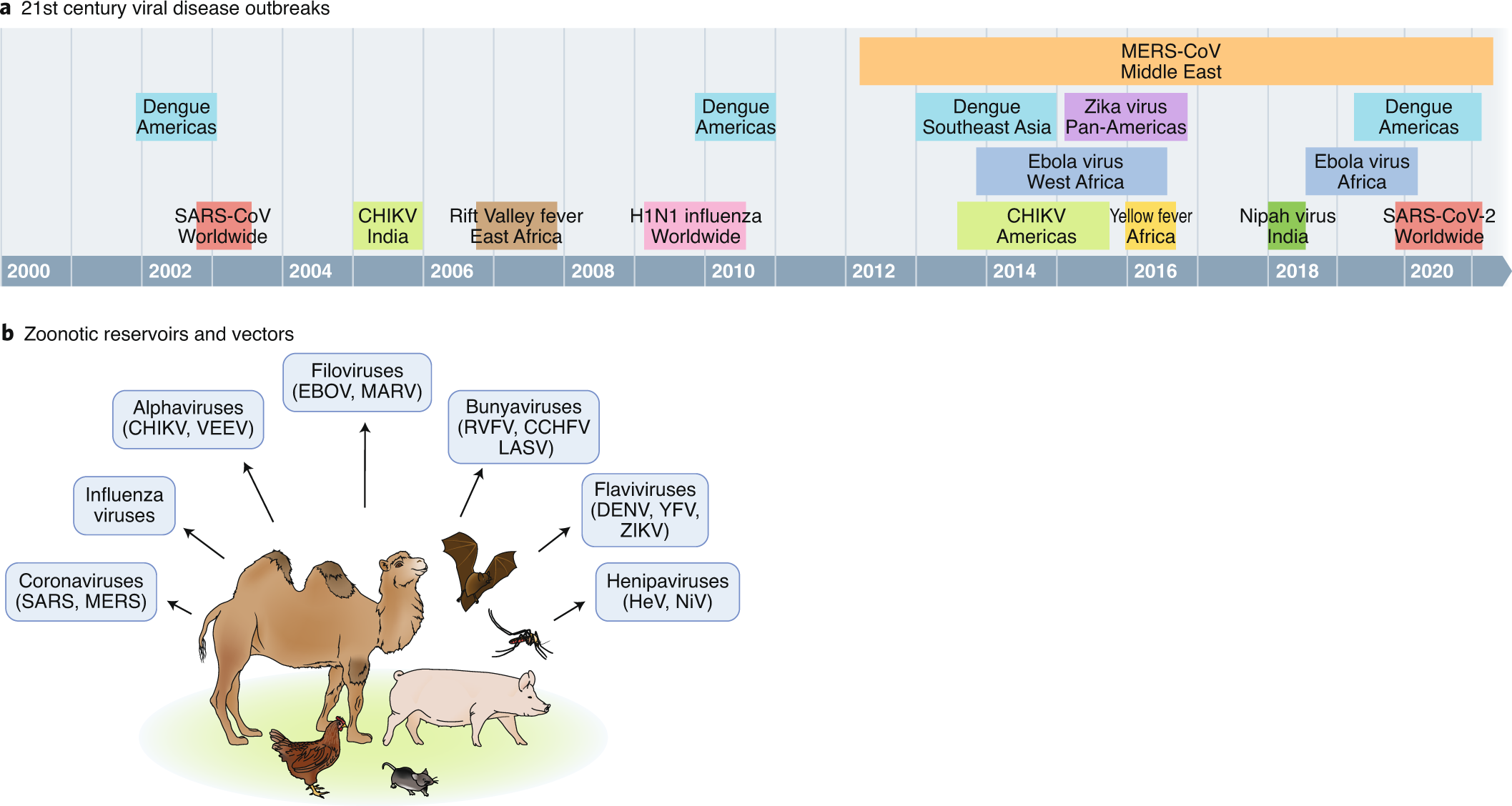 Credits: nature.com
The 21st century has seen a surge in emerging viral threats that challenge public health systems worldwide. One of the most notable examples is the outbreak of the Severe Acute Respiratory Syndrome Coronavirus (SARS-CoV) in 2003, which highlighted the risks of zoonotic viruses, those that jump from animals to humans. This virus, which originated in bats and was transmitted to humans through civet cats, resulted in over 8,000 infections and 774 deaths, underscoring the need for global surveillance and rapid response mechanisms.
Following SARS, the emergence of the Middle East Respiratory Syndrome Coronavirus (MERS-CoV) in 2012 further demonstrated the ongoing threat posed by coronaviruses. Originating from camels, MERS has a higher mortality rate than SARS, though it is less transmissible. The sporadic outbreaks remind us that zoonotic viruses can persist and re-emerge, necessitating continuous monitoring of animal populations and their interactions with humans.
The most significant viral threat in recent years has undoubtedly been the COVID-19 pandemic, caused by the novel coronavirus SARS-CoV-2. First identified in late 2019, COVID-19 quickly escalated into a global crisis, infecting millions and resulting in substantial loss of life. The rapid spread of this virus revealed vulnerabilities in public health infrastructure and the critical importance of virology research in vaccine development and disease management. The unprecedented speed of vaccine development, facilitated by mRNA technology, showcased the advancements in virology that can be leveraged in times of crisis.
Additionally, the emergence of viruses like Zika and Ebola in the early 21st century has emphasized the need for a One Health approach, recognizing the interconnectedness of human, animal, and environmental health. These outbreaks have led to increased funding for research, better understanding of viral transmission paths, and the importance of global collaboration in tracking and responding to viral threats.
As we continue to face new challenges, the rise of antibiotic-resistant bacteria and the potential for viruses to mutate into more virulent strains complicate our efforts. The lessons learned from past outbreaks, combined with innovative research and enhanced global cooperation, will be essential in combating these emerging viral threats.
The Role of Environmental Virology in Public Health
Environmental virology focuses on the interactions between viruses and the environment, which is crucial for understanding how viral infections spread in populations. This field investigates how environmental factors, such as water quality, sanitation practices, and even climate change, influence the transmission of viruses. For instance, in areas with inadequate sanitation, like some communities in Kenya, viruses can easily spread through contaminated water sources. Studies have shown that poor sanitation not only increases the risk of waterborne diseases but also facilitates the transmission of zoonotic viruses, which are viruses that jump from animals to humans.
The presence of viruses in the environment can serve as an indicator of public health risks. For example, monitoring wastewater can help detect viral outbreaks before they escalate into larger public health crises. During the COVID-19 pandemic, wastewater surveillance became a valuable tool in tracking the presence of SARS-CoV-2 in communities, allowing public health officials to implement targeted interventions.
Furthermore, environmental virology emphasizes the need for integrated approaches to public health that consider ecological relationships. By understanding how human behaviors impact the environment and, in turn, how viruses exploit these conditions, public health strategies can be more effective. This holistic view is essential as we face increasing urbanization and climate-related changes that may alter how viruses spread.
Lessons Learned from Virology’s Past for the Future
The history of virology teaches us several important lessons that are crucial for addressing future challenges. First and foremost, the rapid advancements in vaccine development during past outbreaks highlight the importance of preparedness. For instance, the swift development of mRNA vaccines during the COVID-19 pandemic showcased how previous research on other viruses, such as SARS and MERS, laid the groundwork for effective responses. This underscores the need for ongoing investment in research and development, even when a pandemic is not currently looming.
Another lesson is the significance of global collaboration in tackling viral threats. The fight against HIV/AIDS demonstrated that pooling resources, knowledge, and expertise can lead to breakthroughs in treatment and prevention strategies. Similarly, the global response to COVID-19 reinforced the necessity of sharing data and resources across borders to effectively manage public health crises.
Furthermore, virology has revealed the interconnectedness of human, animal, and environmental health. The emergence of zoonotic diseases, like Ebola and COVID-19, emphasizes the need for a One Health approach, integrating efforts across multiple disciplines to prevent future outbreaks. Understanding how environmental factors contribute to viral transmission can help in crafting comprehensive public health policies.
Lastly, public education plays a vital role in controlling viral infections. History has shown that misinformation can hinder vaccination efforts and public health initiatives. Effective communication strategies that promote scientific understanding and trust are essential to encourage community participation in health measures. By learning from our past, we can build a more resilient future in the face of viral challenges.
Frequently Asked Questions
1. What is virology and why is it important?
Virology is the study of viruses and how they affect living things. It’s important because understanding viruses helps us prevent and treat viral infections.
2. How have viruses been studied throughout history?
Viruses have been studied for many years, starting with early scientists who discovered them under powerful microscopes. Over time, research has led to important breakthroughs in vaccines and treatments.
3. What are some major discoveries in virology?
Some major discoveries include the identification of the first virus, the development of vaccines like those for polio and measles, and the creation of antiviral drugs.
4. How do viruses evolve and adapt?
Viruses can change quickly through mutations, which helps them survive and spread. This evolution is one reason they can sometimes evade vaccines.
5. What role did virology play in the recent pandemic?
Virology was crucial during the recent pandemic as scientists identified the virus, studied its spread, and developed vaccines to protect people.
TL;DR The history of virology showcases humanity’s efforts to combat viral diseases, beginning with early discoveries in the late 19th century. Pioneers like Jenner and Pasteur laid the foundation, while Ivanovsky’s work led to the identification of viruses. The field saw significant advancements, including the development of vaccines that have saved millions of lives. However, challenges such as the HIV/AIDS epidemic and emerging threats like COVID-19 underline the ongoing necessity for virology in public health. Environmental virology also plays a crucial role in understanding disease transmission in underserved areas. The lessons learned from the past are vital for future public health strategies.